

[Introduction]In carbon materials research, observing structural transformations at extreme temperatures often involves complex preparation and pre-treatment challenges. How can we accurately track the structural changes of graphite at extreme temperatures and quickly perform XRD characterization?
Today, EWAI highly recommends a powerful, hardcore in-situ tool designed specifically for core graphite and graphene research—the GBC nanoFurnace. Not only does it break the 3000°C extreme temperature barrier, but its unique "no pre-treatment" design also bridges the research loop from "extreme heating directly to XRD testing"!
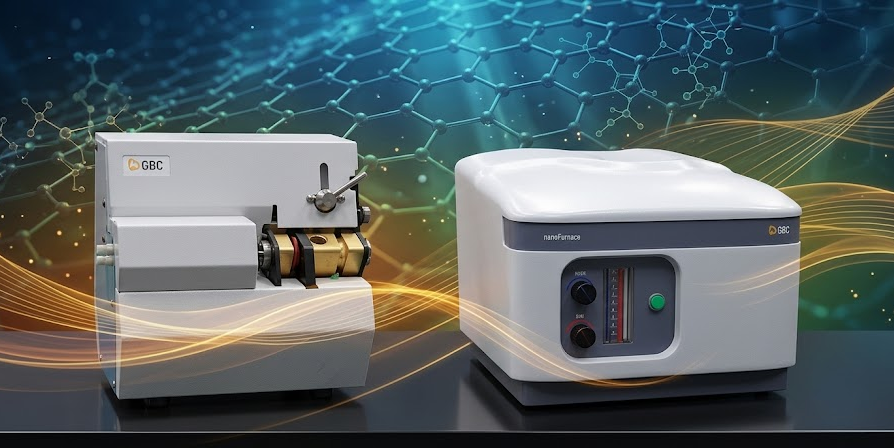
01. Say Goodbye to Tedious Workflows: Seamlessly Integrating High-Temperature Thermal Fields with XRD
Many conventional high-temperature furnaces only stop at the rough sample "pre-treatment" stage (such as ashing or digestion), but the nanoFurnace is a true core research-grade device. Its central value lies in accurately creating extreme thermal conditions for you:
Clear and Rigorous Workflow: To use, simply open the reactor, take out the dedicated graphite tube, place your sample inside, and push the tube back into the furnace. You can then run your program under the specified gas environment.
Seamless Integration with XRD Analysis: The heating process is the critical stage for altering and setting the crystal structure of graphite/graphene. After the sample undergoes the "baptism" of specific high temperatures (up to 3000°C) in the nanoFurnace, its crystallization and structural changes are perfectly locked in. At this point, simply remove the sample to seamlessly transfer it to an XRD (X-ray Diffractometer) for structural characterization.
It provides a highly controllable temperature environment, making it much more accurate to observe the structural evolution rules of graphene under highly efficient thermal fields.
02. Soaring Performance: Breaking the 3000°C Limit, Lightning-Fast
In thermal research, ultra-high speeds often dictate the localized morphological mechanics of material generation. The nanoFurnace boasts astonishing thermal performance:
Extreme High Temperatures: Easily heats up to 3000°C, meeting the ultra-high-temperature research needs of almost all carbon-based materials.
Ultra-Fast Heating Rate: Utilizing highly efficient electrical Joule heating technology, the maximum heating rate reaches an astounding 2000°C/second!
Ultimate Temperature Control: Relying on exclusive Windows software, the temperature adjustment precision is up to 1°C. It supports freely programmable multi-step parameters, accurately capturing every key node during the heating process.
03. Flexible and Safe: Dual Gas Control and Comprehensive Protection
Customizable Atmosphere: The equipment offers two gas line options. In a multi-step heating program, you can select reaction or shielding gases individually or in combination for each step, effortlessly creating the ideal localized gas environment.
Process Visualization (Optional): An optional USB camera can be attached to the work head. Researchers can safely monitor the entire sample treatment process inside the furnace in real-time on a computer screen.
Industrial-Grade Safety Interlocks: The device features built-in safety protections for gas pressure, coolant pressure/flow, undervoltage, and graphite tube damage, ensuring your ultra-high-temperature experiments are completely worry-free.
[Conclusion]
Explore the 3000°C carbon world and decode the structural secrets of carbon materials. The GBC nanoFurnace redefines the efficiency and precision of high-temperature thermal experiments.
Core Parameters at a Glance:
Temperature Range: Up to 3000°C
Graphite Tube Dimensions: Outer Diameter 7.2 mm / Inner Diameter 5.1 mm / Length 24.2 mm
Cooling System: Circulating water chiller
Power Requirements: 208/220/240 V, 15 A (Surge current 40 A)
As a professional analytical instrument supplier, EWAI is committed to providing you with cutting-edge scientific research tools.